Explosion and Fire Hit Quaker Oats Plant in Cedar Rapids, the World's Largest Cereal Mill
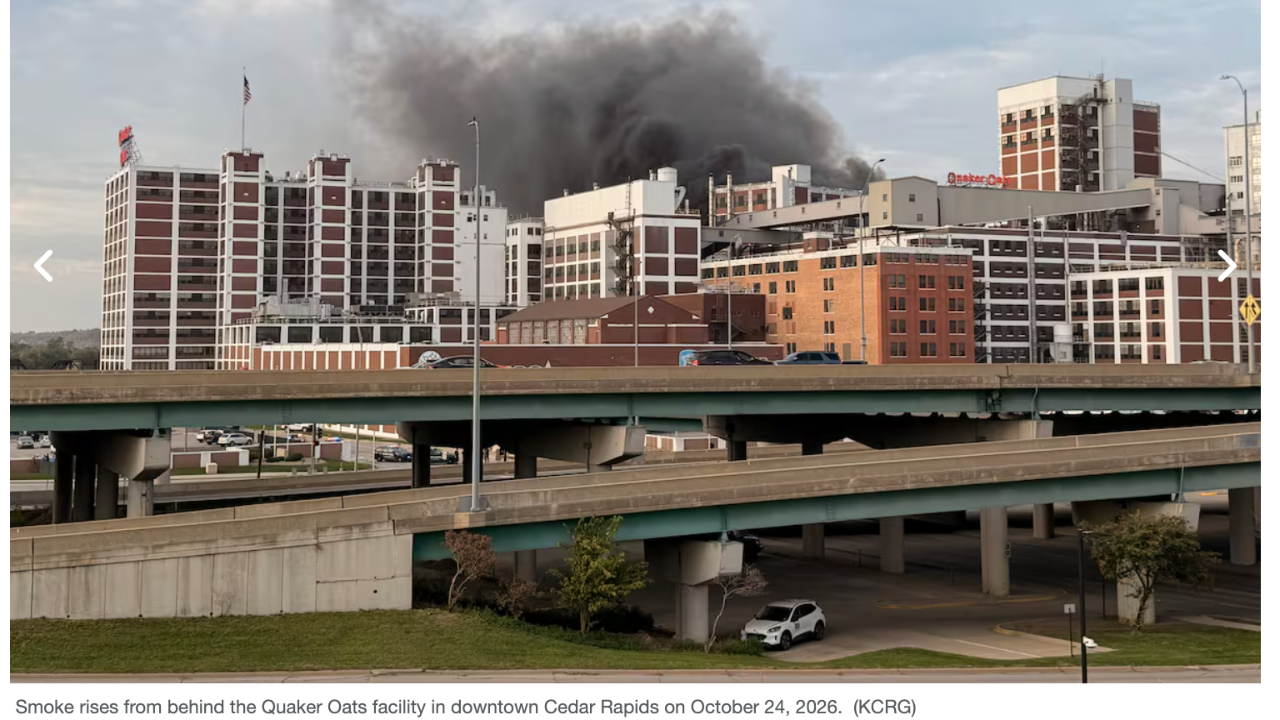
Oct 24, 2026An explosion and fire just hit the Quaker Oats plant in downtown Cedar Rapids, Iowa, the largest cereal mill in the world. Thankfully no one was hurt and every worker was accounted for. But this plant makes a big share of the oats and cereal on grocery store shelves. Nobody knows yet how much damage was done or how long it could be shut down.
▶ Watch the full breaking news video on YouTube
What Happened at Quaker Oats in Cedar Rapids
The Cedar Rapids Fire Department got the call at 4:44 p.m. Central time on Saturday, October 24 for a fire on the back side of the Quaker Oats facility, the side facing away from I-380. When firefighters got there they found heavy smoke and flames coming from the north side of the building, along with evidence of an explosion.
People nearby said they heard and even felt the explosion before thick black smoke started rising over downtown. Traffic on I-380 backed up as the smoke drifted across the interstate.
- No injuries or deaths. All workers were accounted for and no firefighters were hurt.
- Under control by 6:15 p.m. Central time. Crews were still working inside the building into the evening to put out hot spots.
- We don't know the extent of the damage yet or how long the plant could be shut down.
Why This Plant Matters: The World's Largest Cereal Mill
Quaker Oats, a division of PepsiCo, runs the world's largest cereal mill right in downtown Cedar Rapids. The Iowa Department of Natural Resources describes it that way on its own website. This is a huge plant, with hundreds of silos and over a hundred semis of finished product leaving every day.
Products made here include:
- Quaker Old Fashioned and quick oats
- Instant oatmeal packets
- Cereals like Cap'n Crunch, Life and Oatmeal Squares
- Grits, flour and other mixes. Pearl Milling Company pancake mix and syrup also run through this plant.
Oats come in by rail from Manitoba and Saskatchewan, and grain from farmers across the northern U.S. and Canada depends on this plant to get processed. Right now is harvest season. A lot of farmers already have their crop in, but plenty of grain is still waiting to be shipped and processed, and that can take weeks or months when things are backed up. If this plant is down for any amount of time, that could slow things down even more.
The Last Big Explosion Here Was in 1905
This is what makes it so unusual. This plant pretty much never has fires. They haven't had a fire at this facility since the early 1900s. 1905 was the last explosion here, and it was massive. There were casualties, and the plant shut down for a while.
So we're in territory where this hasn't happened in 120 years, and this plant has been going a long time. To have this fire and this explosion here now is definitely concerning, and it could put even more pressure on food prices.
Why are we seeing so much of our infrastructure catch on fire and explode all the time? This isn't a very volatile thing they're working with. It's just oats. It's one thing when it's a manufacturing facility working with metals, or one making explosives for the military. Those are more likely to have fires and accidents. But something like this is huge.
More Pressure on Food Prices
These are staple foods. Oats, cereal and boxed products are supposed to be the cheaper stuff, and they've already gotten really expensive. I buy a lot of these products myself and the prices keep going up. A shutdown at the world's largest cereal mill could push them up even more.
It's on top of everything else hitting our food supply this year:
- Drought early in the season, then record flooding in the fields. Corn has been sprouting and rotting on the ear, and soybean pods are getting moldy from being too wet.
- Diesel prices are up a lot. That raises farmers' costs for running tractors and trucks, and it shows up in food prices.
- A weaker harvest heading into the end of the year and next year.
A String of Food and Supply Chain Fires This Year
This isn't the first time this year that a critical food or supply facility has burned:
- Boyle Heights, Los Angeles (June): a roughly 500,000 square foot cold-storage warehouse burned for 8 days, and about 85 million pounds of food and goods were lost. Crews had to bring in oil-rig water cannons to put it out. It was a hub for distributors to get their cold goods. Walmart would pick up all their cold stuff here, or Sam's Club, or different grocery stores would have it delivered here and go pick it up.
- The Kinder Morgan facility: the paper towel facility that caught fire earlier this year.
- Ontario, California (April): the Kimberly-Clark paper products facility was intentionally set on fire by an employee. He even filmed himself going around lighting paper products on fire. It was a massive distribution hub for places like Walmart and other retailers to pick up their toilet paper, paper towels and other paper products, and it burned to the ground.
- Newark, Delaware (October 8): a fire broke out at the United Cocoa Processors plant.
When we think of critical infrastructure we usually think of pipelines and the power grid. But these warehouses and food plants are critical infrastructure too. They keep our food supply and supply chains running, and every time one goes down it costs millions of dollars and hurts our food security.
How to Prepare for Food Price Spikes and Shortages
- Stock up on shelf-stable staples while prices are normal. Oats, rice, beans, flour and canned goods store well.
- Rotate your pantry. Use the oldest items first so nothing goes to waste.
- Don't panic buy. Build your supply a little at a time every week.
- Have a backup plan for a few weeks of meals in case the stores run low or prices jump.
- Stay on top of the news so you know about disruptions before the shelves show it.
Stay Ahead of the Next Disaster With ReadyAtlas
I built ReadyAtlas to put everything I track in one place, including severe weather alerts, wildfires, hurricanes, flooding, earthquakes, power grid emergencies and air quality. You can see what's happening near you and get ready before it hits. Use it on your phone or computer, with monthly or yearly plans.
👉 Get ReadyAtlas now: monthly and yearly plans
Learn more at ReadyAtlas.org.
▶ Watch the full video: The World's Largest Food Plant just EXPLODED in Iowa
Did you see this fire in Iowa today? What do you think is going on with all these fires and explosions? Let me know in the comments on the video. Stay safe, stay prepared, and stay ready.
Get Every Alert in One Place
ReadyAtlas puts all of these on one live map:
🌋 Earthquakes & Volcanoes
🔥 Wildfires & Fire Perimeters
⛈️ NWS Weather Alerts, Forecasts & Radar
🌀 Hurricane Tracks & Cones
🌊 Tsunami Warnings, Advisories & Watches
⚡ Power Grid Emergency Orders
☀️ Space Weather & Geomagnetic Storms
💨 Air Quality (AQI) & Wildfire Smoke
Set a watch area and get notified when something new pops up near you.
Stay connected with news and updates!
Join our mailing list to receive the latest news and updates from our team.
Don't worry, your information will not be shared.
We hate SPAM. We will never sell your information, for any reason.